
Friday, April 23, 2021

TOEFL, IELTS, GRE, SAT, ACT, AP, SSAT and TEFL, TESOL
TOEFL (Test of English as a Foreign Language) (中国133 考场 刚试了一下听力 比我出国时难了不少) 考费 1350RMB
TOEFL Junior: is measure of English-language proficiency for students age 11 to 15.
雅思 The International English Language Testing System, or IELTS
GRE 考费 1450RMB
以下考試中國沒有考點:
SAT (Scholastic Aptitude Test)
SAT 1, SAT2 (subject tests, 2021 年取消)
ACT (American College Test)
AP (advanced placement)
SSAT ( Secondary School Admission Test ): it's used for admission to private middle schools and high schools. If you're looking to attend an elite private middle or high school, this is a test you'll need to do well on.
EFL(TEFL), ESOL (TESOL), ELL, ESL(TESL), ESP
TESOL(Teaching English to Speakers of Other Languages), used to be called TEFL (Teaching English as a Foreign Language) and TESL (Teaching English as a Second Language). The most recognized qualifications for teaching English abroad to non-native speakers are TEFL nd TESOL certifications. While these two certifications are quite similar, there is a technical difference between them. TEFL allows you to teach English in a non-English speaking country, like China or Russia. TESOL, on the other hand, is a designation for teaching English to second-language speakers in an English-speaking country – study abroad students, expats, immigrants and so on. For most teaching jobs, however, these certifications are treated as equivalents. 120-hours of training is often the minimum requirement for TESOL certifications.
EFL (English as a Foreign Language) meaning: English as a Foreign Language is learning English in a non-English-speaking country. For example, students in China who are learning English are considered EFL students because English is not the official language of the country. But if those same students were in the U.S. learning English, they would be considered ESL students.
ESOL (English to Speakers of Other Languages) meaning: What is ESOL? The meaning of the initialism ESOL is English to Speakers of Other Languages. It applies to both ESL and EFL contexts. One reason why this term was created is because some individuals argue that when students are learning English in a native English-speaking country (ESL), these students are not necessarily learning a second language. It could, in fact, be a student’s third or even fourth language. English as a Second Language, then, is limiting and not fully comprehensive in its description.
ELL (English Language Learners) meaning: The term English Language Learners is commonly used in K-12 environments. It has been brought to my attention, however, that some school districts prefer to use the term ESOL (English Speakers of Other Languages) to describe their student population. This could simply be a preference issue.
ESL (English as a Second Language) meaning: English as a Second Language is learning English in a country where English is dominantly spoken or where English is the official language. For example, students from non-native English-speaking countries who come to the U.S. and Canada for an extended period of time learn English as a Second Language. They acquire English as a means to communicate in the dominant language spoken in the community where they reside.
ESP (English for Special Purposes) meaning: English for Special Purposes includes students who are learning English in context of a certain field, profession, or topic. For example, when I was teaching legal English in China, I was teaching English in context of law. These students were learning English in preparation for studying law through an American university where the professors were all native English speakers.
Source: https://www.readinghorizons.com/blog/what-s-the-difference-between-esl-efl-esol-ell-and-esp
Wednesday, April 21, 2021
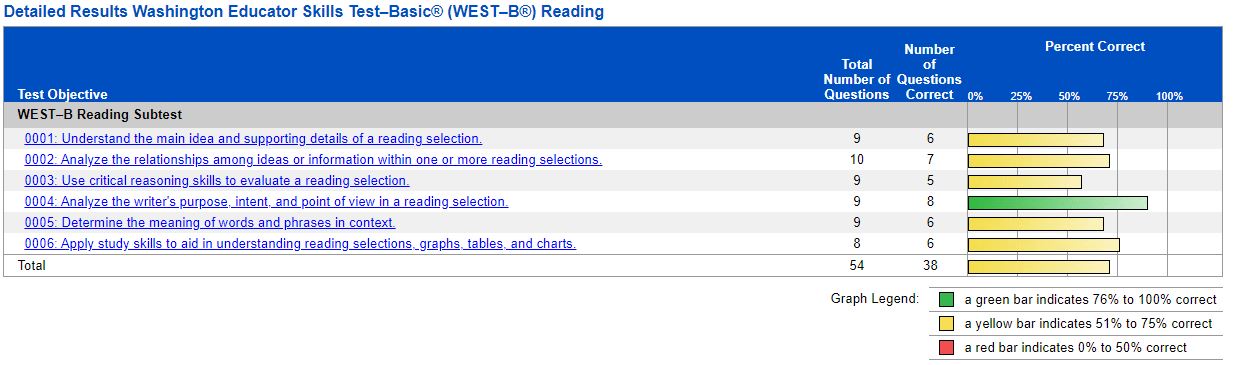
WestB-reading
West-B reading 38/54, 16 wrong answers. 16 articles. I did it in one hour.
Cowards die many times before their deaths. The valiant never taste of death but once.
- William Shakespeare, Julius Caesar




Tuesday, April 20, 2021


Monday, April 19, 2021
Khan Academy Praxis Writing
Praxis Writing: the Basics
Length: 100 minutes, three sections
- Section 1: Multiple choice | 40 minutes
- Section 2: Argumentative essay | 30 minutes
- Section 3: Explanatory essay | 30 minutes
This section of the test is divided into four parts:
- Error identification
- Sentence correction
- Revision in context
- Research skills
Essays
- Argumentative essay (30 minutes)
This essay task will prompt you to discuss the extent to which you agree or disagree with a commonly held opinion.
- Source-based essay (30 minutes)
This essay task will prompt you to extract information from two provided sources to identify important concerns related to an issue.
Each candidate essay is evaluated by two graders on a scale of 1 to 6.
- Clarity
- Consistency of point of view
- Organization of ideas
- Strong and specific supporting examples
- Appropriate diction and syntax
- Correct mechanics and usage
Within-sentence punctuation
Subordination and Coordination
Parallel structure
Modifier Placement
Shifts in verb tense
Pronoun clarity
Pronoun agreement
Subject-verb agreement
Noun agreement
Frequently confused words
Conventional Expression
Logical comparison
Concision
Adjective/adverb confusion
- Incorrect:The photogr
Negation
What is negation?
Negation occurs when the meaning of a statement is altered by the addition of negative words like not, never, and no.
- Incorrect:The photographer didn’t give me no warning when he took the picture.
- Correct:The photographer didn’t give me any warning when he took the picture.
or
The photographer gave me no warning when he took the picture.
The Praxis Core Writing tests two types of negation error:
- Double negatives
Double negatives occur when multiple negative words are used redundantly.
Negative + “barely” words
Words like barely, scarcely, and hardly suggest an action almost didn’t happen, but ultimately did.
Negative words state that an action didn’t happen at all.
Therefore, combining negative words with words like “barely” creates a contradiction. [Hide example]
- Incorrect:There was barely no food left in the refrigerator.
- Correct:There was barely any food left in the refrigerator.
Explanation: “Barely” suggests there was a little food in the refrigerator. “No” suggests there wasn’t any food in the refrigerator. Using both creates a contradiction.
- Top tip: Look for split negatives
Double negatives can be harder to see if they’re split up by a verb phrase or a descriptive aside.
Any time a negative word is underlined, comb closely through the entire sentence to see if another negative word or a “barely” word is hiding anywhere.
- Incorrect:Hannah and Jason could not, despite their best efforts, find no trace of the missing car keys.
- Correct:Hannah and Jason could not, despite their best efforts, find any trace of the missing car keys.
Explanation: A combination of two negative words, even when separated by other phrases, creates a negation error.
Top tip: Fix the common flaw
Negation is a common error type. If a negation error is present, forget anything else that might seem weird to you about the sentence—the choice that fixes the common flaw will be the answer.

Capitalization
What is capitalization?
Capitalization refers to conventions for when a word should start with a capital (uppercase) letter.
- Incorrect:Humans are from a planet called earth.
- Correct:Humans are from a planet called Earth.
Explanation: "Earth" is the name of a specific place. It is therefore a proper noun that must be capitalized.
Capitalize the following words and phrases:
- Proper nouns
A proper noun is a name or title used for a specific person, place, or organization.
Examples: Batman, South America, U.S. Department of State
- Proper adjectives
A proper adjective is a descriptive word derived from a proper noun.
Examples: Shakespearean, East African, Portuguese
- Capitalize by context
Any word can require capitalization if it appears in the right context.
Even if a word isn't usually capitalized, it needs to be capitalized if it appears in a proper noun phrase.
- Incorrect: Madison Square garden is the home of the New York Knicks.
- Correct: Madison Square Garden is the home of the New York Knicks.
Explanation: "Madison Square Garden" is a proper noun phrase. So even though "garden" is not a proper noun on its own, it must be capitalized in this context.
- Capitalize languages
The names of languages are both proper nouns and proper adjectives. They must be capitalized.
- Incorrect:The latin phrase "tempus fugit" means "time flies".
- Correct:The Latin phrase "tempus fugit" means "time flies".
Be careful with directions
Take extra care with cardinal directions (north, southern, etc.).
They are capitalized when they refer to a specific, named region (e.g., the American South).
They aren't capitalized when they describe relative directions (e.g., the southern United States).
- Incorrect:Utqiagvik, Alaska is further North than any other city in the United States.
- Correct:Utqiagvik, Alaska is further north than any other city in the United States.
Explanation: Because "north" isn't part of a place name in this context, it shouldn't be capitalized.
Fix the common flaw
Flawed capitalization is a common error type. If it is present, forget anything else that might seem weird to you about the sentence—the choice that fixes the common flaw will be the answer.
Our mission is to provide a free, world-class education to anyone, anywhere

Apostrophe use
What is apostrophe use?
Apostrophe use refers to how an apostrophe ( ' ) can be used to show possession.
- Incorrect: Kens car needed to be cleaned.
- Correct:Ken's car needed to be cleaned.
What's on the test?
The Praxis Core Writing tests apostrophe use in the following instances:
- Plural nouns
Plural nouns do not require an apostrophe.
The plants in the greenhouse are thriving.
- Singular possessive nouns
Singular possessive nouns require an apostrophe followed by an "s".
The company's most popular products include shampoo and moisturizer.
Note: This rule applies even if the singular noun already ends in "s" (e.g. the rhinoceros's horn).
- Plural possessive nouns
Plural possessive nouns that end in "s" require an apostrophe after the "s".
On many superhero teams, the heroes' costumes are each a different color.
Note: If a plural noun doesn't end in "s", then an "s" should be added after the apostrophe (e.g., the men's swim team).
- Top tip: It's vs its
Whenever you come across “it’s” (with an apostrophe), get rid of the contraction and read it as “it is”.
When you get rid of contractions, usage errors become more obvious.
- Incorrect:The dog was chasing it's tail.
- Correct:The dog was chasing its tail.
Explanation: "The dog was chasing it is tail"? That can't work!
- Top tip: Possessive pronouns
Unlike possessive nouns, possessive pronouns never require an apostrophe.
Possessive pronouns include yours, mine, its, theirs, hers, his, and whose.
- Top tip: Fix the common flaw
Flawed apostrophe use is a common error type. If it is present, forget anything else that might seem weird to you about the sentence—the choice that fixes the common flaw will be the answer.
Our mission is to provide a free, world-class education to anyone, anywhere.

Khan Academy Praxis Reading
About Praxis Core Reading
Length: 85 minutes
Format: 56 passage-based multiple choice questions
- Key Ideas and Details
- Craft, structure and language skills
- Integration of knowledge and ideas
The test consists of four types of stimulus material:
- Paired passages totaling approximately 200 words followed by four to seven questions
- Long passages of approximately 200 words with four to seven questions
- Short passages of approximately 100 words with two or three questions
- Brief statements followed by a single question
Questions in each of the formats may pose tasks of varying difficulty and test any of the following skills:
- Main idea
- Supporting ideas
- Meanings of words
- Organization
- Inferences
- Evaluation of evidence
- Purpose of components '
- Relationship of ideas
- Facts or opinions
- Author’s attitude
- Recognize similar situations
- Draw conclusions
To be facts, claims need to be supported by evidence and logic, not just the perspective of the author.
Subscribe to:
Posts (Atom)