Showing posts with label TOEFL. Show all posts

Saturday, June 5, 2021

TOEFL Preparation Specialization, UCI

ETS website

TOEFL iBT (internet Based) Test Content

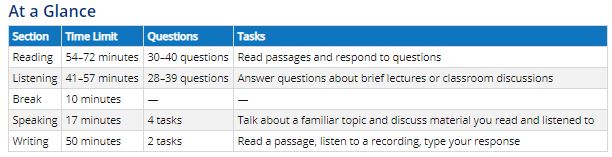
The TOEFL iBT test has 4 sections: Reading, Listening, Speaking, and Writing. During the test, you'll perform tasks that combine these 4 English communication skills, such as:

  • read, listen and then speak in response to a question
  • listen and then speak in response to a question
  • read, listen and then write in response to a question
  • The total test takes about 3 hours to complete, but you should plan for 3½ hours, allowing 30 minutes for check in.

https://www.ets.org/toefl/test-takers/ibt/about/content/


UCI: University of California Irvine

TOEFL Preparation Specialization

The TOEFL iBT test helps you stand out confidently in English. It's accepted by more than 11,000 universities and other institutions in over 150 countries. Conveniently offered weekly at authorized test centers near you, the computer-delivered TOEFL iBT test is the only test that measures all 4 academic English skills — reading, listening, speaking, and writing.

https://www.coursera.org/specializations/toefl-preparation

COURSE 1 TOEFL Reading and Listening Sections Skills Mastery
COURSE 2 TOEFL Speaking and Writing Sections Skills Mastery
COURSE 3 TOEFL Test-Taking Strategies

Check my blogs about course notes:


COURSE 1 TOEFL Reading and Listening Sections Skills Mastery
It has changed since August 2019. IBT stands for internet-based TOEFL and TOEFL stands for a test of English as a foreign language. It is required for every learner whose first language is not English in wishes to study in an English speaking country. The test is created and administered by ETS, Educational Testing Service. This organization creates many other well-known tests, like GRE or TOEIC.

The test is interactive, which means that you interact with a computer and then respond to the test items. It is an academic test, focusing on the skills that test takers need to succeed in any academic or educational setting.

The test includes four skills Reading, listening, speaking, and writing respectively. The entire test takes about three to three and a half hours to complete. 


Recently, ETS offers a new feature called My Best Score. It combines your best scores for each section from all your valid scores in the last two years so you can show schools your best performance.  You'll receive a score from 0-30 for each section and a total score of 0-120 for the entire test. Scores are valid for two years after your test date. You can try for a better score as many times as you'd like. There are unlimited retakes. Your official scores for all four sections of the test will be ready in approximately seven days. 


The reading section measures your ability to understand university level academic texts and passages. In iBT the main focus is on the ability to find and understand basic and detailed information as well as to recognize the purpose of a passage and how it is organized.

There are 3 passages in each passage includes 10 questions. Sometimes in the reading or listening sections, you will see more than 10 questions, but some of those questions are for research purposes and won't be graded.


The listening section measures your ability to understand spoken English and academic setting.

Learners need to be able to listen to various lectures and conversations. Just like the reading section, you'll need to listen to understand basic and detailed information, and connect, and synthesize information. This section includes three academic lectures with 6 questions each and 2 Campus Conversations with 5 questions each.


As mentioned, there may be some extra questions that ETS uses for research purposes.

The questions will appear either in the reading section or the listening section, but never in both. These questions help ETS, to make scores comparable across administrations and determine how such questions function, under actual testing questions. Simply put, ETS wants to know if those questions are good questions, to keep or not


The speaking section measures your ability to speak effectively in academic and campus settings. It's about 15 to 17 minutes long, and includes four tasks. The first task is called independent tasks. It asks you about your opinion or experience about the topic. The rest of the tasks are called integrated tasks, because they require you to use more than your speaking skills. You may need to read and listen before you speak.

You will need to speak your response to a microphone and your answers will be recorded and sent to ETS for grading.


This section measures your ability to write in English in academic setting. There are two tasks to complete. The first one is called integrated task. Like the integrated speaking task you'll need to read and listen before you write. You'll have 20 minutes to type your response. Next you will see the independent writing.You'll have 30 minutes to write about an academic topic


Score:

You will receive 4 scaled section scores and a total score. Each of the four scales has a score range of 0-30. These are then added for a total score of 120.


The tests are scored by a centralized scoring network, never at the test center. The Reading and Listening sections are scored by the computer and you can see them as soon as the test is completed. Their responses to the Speaking and Writing sections are scored by a combination of 3-6 certified human raters and advanced computer software raters. In order to one, offer a complete and accurate picture of your ability. Two, minimize the rater bias that can occur with face-to-face interviews. Three, to ensure consistency and the highest quality. Your Speaking and Writing scores may take 7-10 days to be mailed to you.


We know that the highest possible score in the test is 120, but you may wonder if there is a passing score. My answer is, there are no passing scores or failing score is set by TOEFL programs or ETS. Rather, the score you'll need depends on what school or program you intend to apply for it. Test takers should consult their target institution to determine their specific TOEFL score requirements.


Recently, ETS offers a new feature called My Best Score. It combines your best scores for each section from all your valid scores in the last two years so you can show schools your best performance


Summary: 

  • School requirements are set by individual colleges and universities. 
  • You'll receive a score from 0-30 for each section and a total score of 0-120 for the entire test. 
  • Scores are valid for two years after your test date.
  • You can try for a better score as many times as you'd like. 
  • There are unlimited retakes.
  • My best scores combined your best scores for each section from all of your valid scores in the last two years so you can show schools your best performance. 
  • At the end of your tests, you will see your unofficial scores for the Reading and Listening sections. This will help you make a well-informed decision about reporting your scores. 
  • Your official scores for all four sections of the test will be ready in approximately seven days. You can view them easily online. You can download a PDF copy of your score report from your account within eight days after the test.
Friday, June 4, 2021

TOEFL Reading

 TOEFL Reading


Source: https://www.coursera.org/learn/toefl-reading-listening-sections-skills-mastery/supplement/ujiyG/the-ibt-reading-questions

The reading section is the first section you will see on an iBT test. It tests your ability to understand academic reading material. Academic means the passages are like what you would find in a textbook at university. All fields of study from chemistry to literature to psychology, etc. are possible topics of the reading passages. You will need to read three passages and, on average, the length of each is about 700 words.

Even if you are not familiar with the topic, if your English is good enough, you will be able to answer all the questions based on the information in the reading passage. If you see a highlighted word, you can see the definition for it by holding your mouse over it.

When doing the reading section, the question is on one side of your screen and the passage is always available on the other side. When you start each reading passage, it's best to read it quickly. Many of the questions will refer to a specific paragraph, so you can then re-read that section. You don't want to run out of time! Also, you can click through all the questions of a given passage, so you don't have to answer them in order. Answer all the ones you think are easy and then use the rest of your time to do the harder questions. To make sure you don't miss any, there is a review button that will open up a screen listing all the questions and show if they were answered or not. There are links that allow you to quickly go to any question.

Let us explore and see what reading questions look like. The following link will take you to the website that shows you different questions you will need to answer as well as the number of each of the questions. It might seem like some of the question types are the same, but in the videos you will learn more and will be able to recognize each question type. Understanding question types is very important in improving your score. That’s because each question type can be approached differently and you can use certain strategies to answer these questions. We will talk about those strategies in Course 3. However, let’s get started with understanding iBT question types now. 

A Final Note: TOEFL Reading Question Types and Strategies PDF

iBT (internet-based test) reading section


Review button

  • The three reading passages are about 700 words long and have about 10 questions each. You have about 54-72 minutes to read and answer the questions. These passages are taken from university-level, textbooks and are hardly modified. That means they are not edited for the test purpose too much.


TOEFL Listening

TOEFL Listening


You can't see the questions as you listen.

The listening section of the iBT test comes after the reading section and has five parts. There will be two conversations and three lectures. Each conversation is followed by five questions. The conversations are mostly about topics related to campus issues like housing, the library, cafeteria, parking, etc. That’s why they are sometimes referred to as “campus questions.”  Just like reading, the lectures are taken from a variety of academic topics like the arts, life sciences, physical sciences, social sciences, etc. The lectures are followed by six questions. 

Listening Question Types

Most of the listening questions that follow the lectures and conversations are traditional multiple-choice questions with four answer choices and one correct answer. However, there are some multiple-choice questions with more than one correct answer. For example, there might be questions with five answer choices, two of which are correct answers. There are also questions that ask you to put events or process steps in order as well as to fill in table questions that we have looked at in the reading section of the test.

Now you can click on the link below.  Just like the previous section about the reading test, you will have a chance to become familiar with the different question types you need to answer.

https://www.testden.com/toefl/listening.htm


on the screen when speaker mentions them.


Irony means the language signifies the opposite typically for humor or emphatic effect. These questions are usually phrased as, what is the professor's attitude toward X? What is the professor's opinion of X? Or what does the woman mean, when she says this.


TOEFL Speaking

COURSE 2 TOEFL Speaking and Writing Sections Skills Mastery


Question 1 How many integrated speaking tasks are in the speaking section?
3

Question 2
How much preparation time is allotted for the campus conversation question?
30 seconds

Question 3 For your integrated tasks, your response time will be ________ .
60 seconds

Question 4 Is the following statement true or false?

In the last speaking question, the summary question, there is no reading required before you listen.
True

Question 5 Is the following statement true or false?

In the integrated questions, you can express your personal opinions and/or preferences.
False

My comment建议ETS把 speaking and writing  全部取消。这样的文章不如不写。这样的模板训练有极大的坏处。


The Independent Task:


After 15 seconds have passed, you'll hear a beep, and you will then have 45 seconds to deliver your response. On-screen clock keeps track of time, a second beat will tell you that you should stop speaking. After that, you'll see the prompt for the next question.  

You will not be penalized if you have not finished your response when the time is up, as long as you have completed most of the task as given in the prompt.


Scoring criteria used by the readers include, delivery, language use, and topic development. 
  • Delivery is about how clear your speech is. Good responses are those in which the speech is clear with good pronunciation, natural pacing, and natural sounding intonation patterns. 
  • Language use depends on how effectively you use grammar and vocabulary to convey your ideas. Readers will be listening for how well you can control both basic and more complex language structures and use appropriate vocabulary. 
  • Topic development is about how fully you answer the question and how coherently you present your ideas. Good answers generally use all or most of the time allotted and the relationship between ideas and the progression from one idea to the next is clear and easy to follow.


For example, you can say, in my opinion, X is better than y because, or personally, I enjoy X for two or three reasons. Or you can say I enjoy or I like X because. Or my best or my favorite X is, and rest of the sentence. Or you can say, I would like to, and then use a verb, the action, and then the reason, because. Another option is personally, I believe X is better than Y, for two or three reasons. In my opinion, X seems to be better than Y because, or you can say, I prefer, or I would prefer X over Y because, and then the rest of the sentence. Finally, another option is to me, X is better, opinion, than Y, and I feel this way for two or three reasons. Remember, these are all suggested templates, and there is no right or wrong answers.


Step two, this part is optional if you have already included the number of reasons, in your previous sentence. If you have not, then you can introduce the number of reasons you have for selecting your subject. Examples are, like one, I feel this way for two or three reasons. Or the second example is, this is because of two or three reasons. Or another option is, I have two or three reasons.


Step 3: for example, mention the example or a first off, write the reason, for instance, support your answer with examples, or for one. Again, write your reason. That is, followed by example. My first reason is that, mention the reason here, what I mean is that, here provides some details. Or you can say for one and then mention the first reason. Then for instance, explain your example. Finally, you can say one reason is that, put your sentence here. What I mean by this is that, and here you will explain exactly what you mean.


Integrated Speaking Questions

The first integrated task or question number two is frequently called the “campus question.” You will read a passage about a campus-related topic. Next, you will listen to a conversation about that topic. You will then have 30 seconds to prepare your response and 60 seconds to speak your answer. For question two, where you have both reading and listening passages, you will be asked what the opinion is of a speaker in the listening passage, and you’ll need to explain how that person’s opinion relates to the issues presented in the reading passage.

In question three, you will read a passage about an academic subject. The reading passage will always be about an important academic term or concept that might be found in a college textbook. Next, you will listen to part of a lecture on that same subject. You will then have 30 seconds to prepare your response, and 60 seconds to speak your answer.

In question four, you will listen to part of a lecture which is followed by a question. Next, you will have 20 seconds to prepare your response and 60 seconds to speak your answer, which will always be a summary of the lecture. Now, let’s look more closely at what these academic-courses questions look like and what they will be asking you to do.

Please go through the questions in the given sample test so that you can watch the videos with better understanding of what the questions look like. This sample test is available on the ETS website. It will take approximately 17 to 20 minutes to complete all four speaking tasks. The following link will take you to the website where you can download the test.